
Introduction
The British pound (GBP) is most often analyzed against the U.S. dollar or the euro, but its relationship with commodity currencies like the Australian dollar (AUD), Canadian dollar (CAD), and New Zealand dollar (NZD) offers equally important insights. GBP vs commodity currencies reflects not only UK economic strength but also global demand for commodities such as oil, gold, and agricultural exports. Understanding how these forces interact can help traders spot unique opportunities in the forex market.
What Are Commodity Currencies?
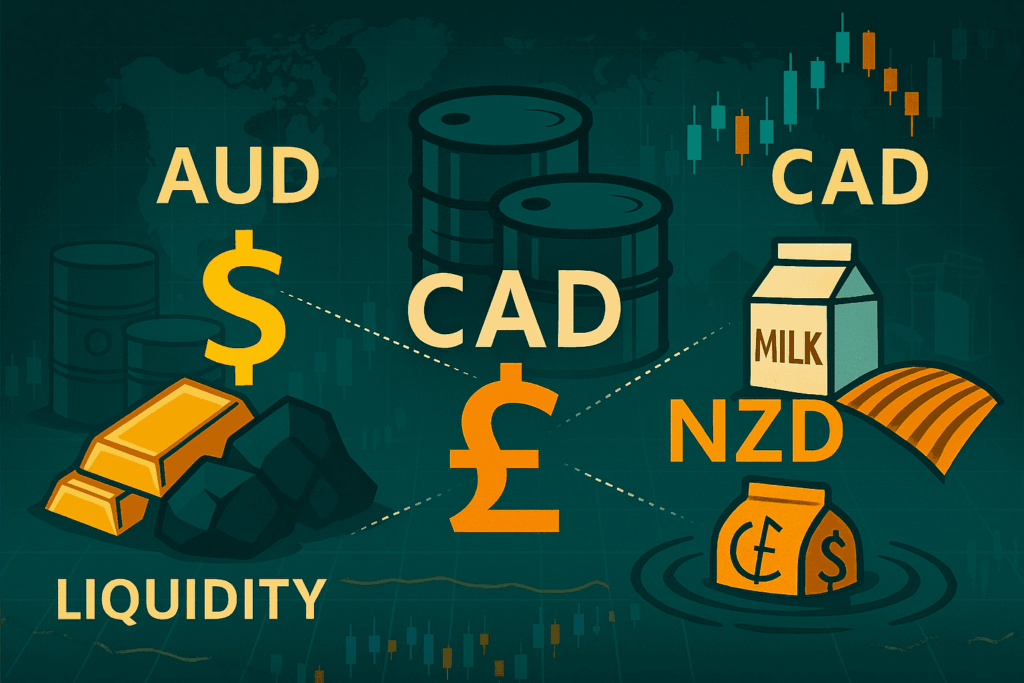
Commodity currencies are those strongly linked to the export of raw materials and natural resources:
- AUD (Australian Dollar): Driven by global demand for iron ore, coal, and gold.
- CAD (Canadian Dollar): Heavily influenced by oil prices due to Canada’s large energy exports.
- NZD (New Zealand Dollar): Sensitive to dairy and agricultural exports.
When trading GBP against these currencies, movements often depend more on global commodity cycles than domestic UK data.
GBP/AUD: A Battle Between Services and Resources

The UK’s service-based economy contrasts sharply with Australia’s resource-driven exports. GBP/AUD often reflects risk sentiment and Chinese demand for Australian commodities. If China’s economy slows, AUD weakens, favoring GBP gains. Conversely, rising commodity prices strengthen AUD, putting pressure on GBP.
GBP/CAD: Oil as the Decisive Factor

The Canadian dollar is often dubbed a “petro-currency.” When oil prices rise, CAD tends to strengthen against GBP, since Canada benefits from higher energy revenues. On the other hand, falling oil prices usually weaken CAD, creating opportunities for GBP/CAD traders. Traders should closely monitor Brent and WTI crude movements when analyzing this pair.
GBP/NZD: A Play on Agriculture and Risk Appetite

The New Zealand dollar is highly sensitive to dairy exports and global risk sentiment. GBP/NZD tends to move sharply during periods of market uncertainty, with traders often treating NZD as a higher-risk asset. In risk-off environments, GBP usually outperforms NZD, while in risk-on conditions, NZD can rally strongly against GBP.
Trading Strategies for GBP vs Commodity Currencies

- Follow Commodity Prices: Oil for GBP/CAD, metals for GBP/AUD, and dairy/agriculture for GBP/NZD.
- Track Global Growth Trends: Strong Chinese demand often boosts AUD and NZD, while global slowdowns support GBP.
- Watch Risk Sentiment: In times of global uncertainty, GBP often strengthens as traders exit riskier commodity currencies.
- Pair Fundamentals with Technicals: Use key support/resistance levels while aligning trades with macro drivers.
Conclusion
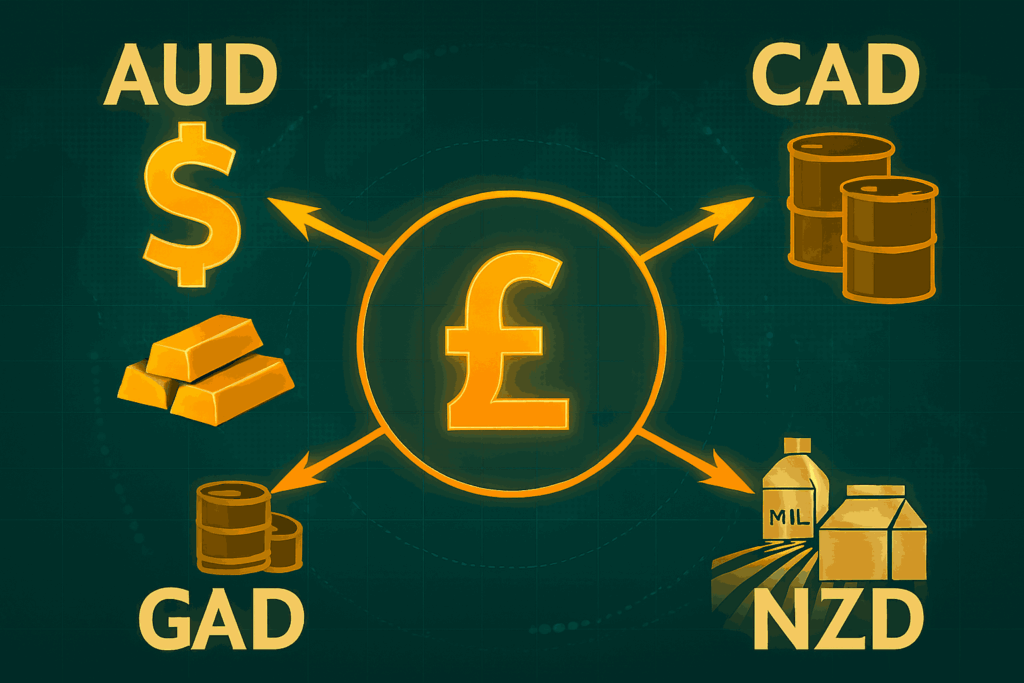
Trading GBP against commodity currencies requires a different lens than GBP/USD or GBP/EUR. Here, global demand cycles, commodity prices, and risk sentiment dominate. By monitoring both UK fundamentals and the forces shaping AUD, CAD, and NZD, traders can identify high-probability setups across these pairs in 2025.